Swap what's worn
BRM tells you which bearings still have a long life ahead, and those stay in. You replace only the worn ones and stop spending money on parts that were fine.
BRM 9001 AI rides your conveyors and lifts like any other carrier. The AI on the module checks every roller and guide bearing it passes and names the exact roller that is wearing out, while there is still time to plan the swap.
Thanks. We will contact you about the BRM 9001 AI pilot program.
We only e-mail you about BRM 9001 AI: pilot, availability and product updates. Unsubscribe any time. Privacy policy
1roller
Every finding points to one exact roller.
1ride
Conveyor rollers and lift guide bearings on the same trip.
0cables
to install. It travels in a carrier.
100%
of the analysis runs on the module. Raw data stays there.
Jury from Infineon Technologies, ZEISS Digital Innovation, WAKU Care and HTW Dresden · Team TBD: Think Ahead Technologies with Smart Systems Hub
No installation on the line. The AI travels with your normal traffic.
Put BRM 9001 AI in a carrier you already run. Nothing is installed or wired on the line.
BRM travels your routes with normal traffic. The model on the module checks every roller and guide bearing as it passes, in real time.
BRM names the exact roller and sends a work order with location and severity to the technician on shift or your maintenance system.
BRM 9001 AI joins the traffic, passes every roller, turntable and lift on its route and reports the parts that are wearing out, each pinned to its exact location.
Rides along
In a regular carrier, with normal traffic
Spots wear
Rollers, turntables and lifts on one trip
Sends the ticket
Exact location straight to maintenance
Every anomaly becomes a work order with route and the exact roller. It lands on the phone of whoever is on shift, and they walk to the spot and fix it.
The AI on the module spots a worn bearing while the carrier passes it.
Route 07 · roller R-05 · 2.0 m from the transfer point. Exact roller identified.
A work order lands on the phone of the on-shift technician.
The technician goes to the right roller and puts the ladder up once.
BRM 9001 AInow
Critical: bearing R-05 · Route 07
Roller R-05 · 2.0 m from transfer point · rattle
Calendar swap
Too early
Swapped while still healthy. Good life thrown away.
Run to failure
Too late
Swapped after it broke. The line stopped first.
BRM 9001 AI
Right on time ✓
Swapped when wear shows, in a planned slot.
BRM tells you which bearings still have a long life ahead, and those stay in. You replace only the worn ones and stop spending money on parts that were fine.
Damage shows up before it affects material flow. That means fewer unplanned stops, less lost output and no scrap from stalled lots.
You know where a bearing is going to fail and roughly when. Emergency calls become scheduled jobs, and the hours spent inspecting and searching go away.
Put in your number of bearings, swap interval and the cost of a stopped hour. The calculator shows what condition-based swaps could save in a year. Built to share with whoever signs off the budget.
Four ways to look after the same line. The strip shows which rollers each one actually reaches. Roller 9 is the one wearing out.
Someone walks the line and listens.
3 of 12 checked · worn roller missed
Sensors wired to selected points.
3 of 12 checked · worn roller missed
Spot measurements with a portable meter.
2 of 12 checked · worn roller missed
Rides with normal traffic and checks every roller.
12 of 12 checked · worn roller found
Wherever material moves on roller conveyors or through lifts, BRM 9001 AI rides along. Pharma and food production are on the list too.
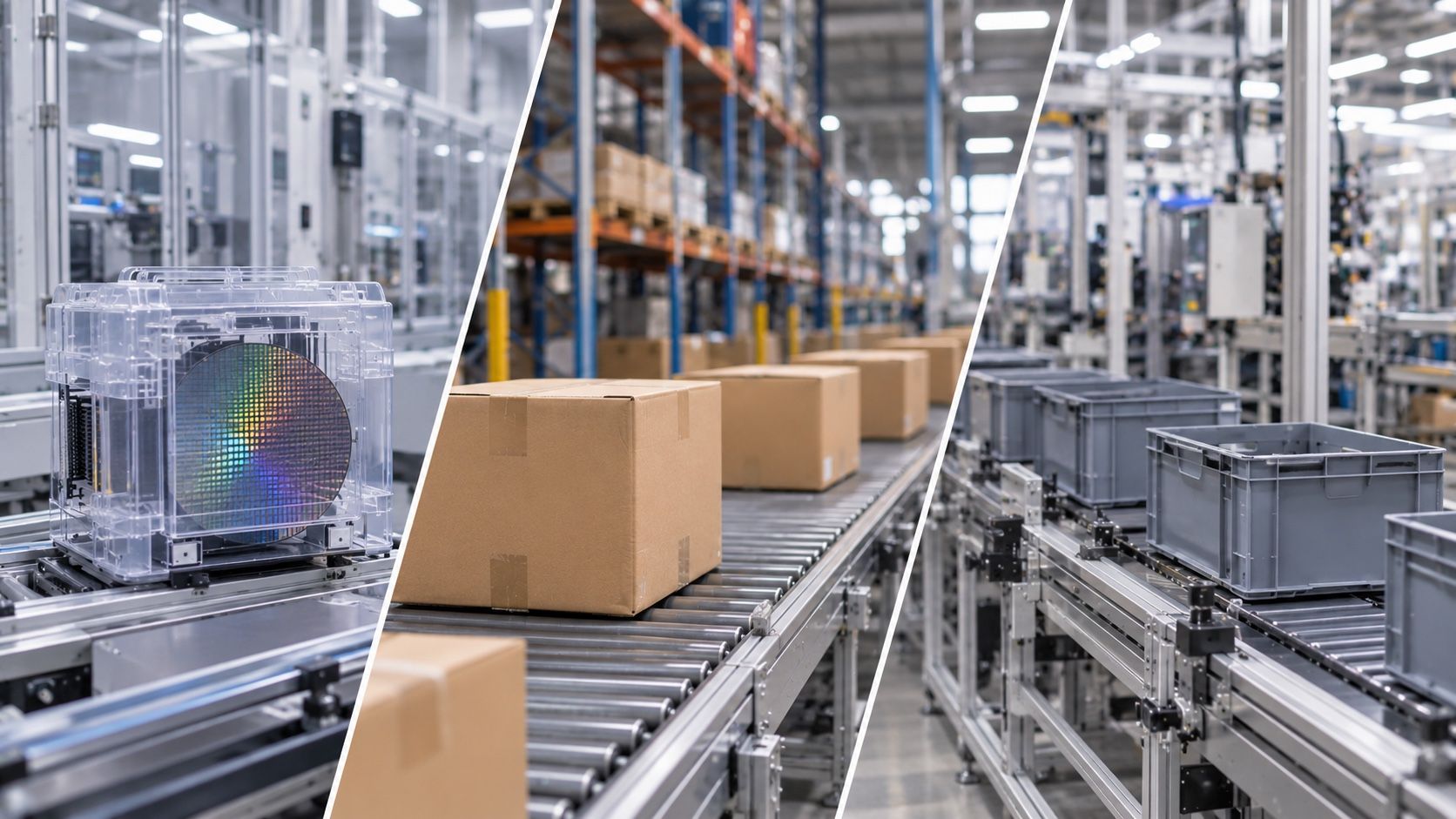
Semiconductor & electronics
Wafer carriers on cleanroom conveyors and lifts
Intralogistics & warehousing
Cartons and parcels on roller conveyors
Automotive & manufacturing
Small load carriers between stations
The model runs on the board inside the carrier. Findings exist the moment the carrier passes the roller, with or without a network. Only results leave the module.
Every finding points to one exact roller, on the conveyor and in the lift shaft. Out of 4,000 bearings, you know which one is failing.
Every finding gets a severity from info to alarm. Mark a false alarm once and BRM stops reporting it.
BRM learns what healthy looks like on your conveyors and lifts and flags what deviates: blocked rollers, rough running, rattling bearings.
Horizontal rollers and lift guide bearings are checked on the same trip, each with its own model. Stockers and overhead transport come next.
Made for roller conveyors and lifts in manufacturing and intralogistics, from warehouses to cleanrooms.
“We don't make mistakes. We predict happy little failures.”
BRM 9001 AI is a mobile sensor module with edge AI on board, built for predictive maintenance of roller conveyors and lifts. It rides along in a regular carrier and detects worn or failing rollers and bearings on the way.
The AI model runs on the module itself, not in a cloud or data center. Findings are produced in the carrier while it travels, even without a network connection. Raw sensor data never leaves the module.
BRM learns what a healthy line looks like and flags deviations such as blocked rollers, rough running or rattling bearings. The analysis runs on the module. We share technical details with pilot partners under NDA.
Yes. BRM checks the guide bearings of vertical lifts on the same ride as the conveyor rollers and assigns every finding to the right lift and position.
Every finding becomes a work order with the exact location (route, roller or lift position), the fault type and a severity. It goes to the technician on shift or directly into your maintenance system.
No. BRM mounts on a standard carrier and travels with normal traffic. Results are buffered on the module and synced whenever Wi-Fi is available.
All analysis runs on the module. Raw sensor data is not stored or transmitted, only findings. Nothing is wired into your line. We go through the details with your IT and OT security team during the pilot.
BRM 9001 AI is built for roller conveyors and lifts in manufacturing and intralogistics, for example automated warehouses, automotive and supplier plants, electronics and semiconductor production, pharma and food. Stockers and overhead transport are on the roadmap.
The BRM 9001 AI pilot program opens in Q2 2027 with a limited number of slots. Join the waitlist to apply.
The first BRM prototype was built in three days on a conveyor test rig in Dresden. A jury from industry and research ranked it first. Since then we have been turning the prototype into a product.
Dresden, June 2026 · click to enlarge
Thanks. We will contact you about the BRM 9001 AI pilot program.
We only e-mail you about BRM 9001 AI: pilot, availability and product updates. Unsubscribe any time. Privacy policy